Sabtu, 07 September 2024

Buku "ekonomi Pancasila dan ekonomi syariah"


Syahyuti. 2024. Kesejajaran dan inklusifitas EKONOMI KERAKYATAN, EKONOMI PANCASILA, dan EKONOMI SYARIAH: sebuah catatan pengantar (draft 29 Agust 2024)

https://drive.google.com/file/d/1JOGyPdiVLXga2rC6hoq52djRlbp6yA6r/view?usp=sharing


Kata Pengantar

Ada tiga istilah yang satu sama lain berdekatan, namun adakalanya juga saling dipertukarkan. Ketiganya itu adalah “Ekonomi Kerakyatan”, “Ekonomi Pancasila”, dan “Ekonomi Syariah”. Semuanya berasal dari ilmuwan Indonesia, sebagai upaya mencari bentuk konsep ekonomi alternatif yang dirasa lebih sesuai di Indonesia, dan sebagai bentuk kritik terhadap teori-teori ekonomi dari Barat. Ketiga sistem ekonomi ini cukup ramai di lingkungan akademis, dengan perhatian yang pasang surut. Meskipun Ekonomi Syariah atau Ekonomi Islam tentu saja praktek yang lebih tua, dan mestinya ilmunya juga lebih dahulu (abad ke 7 masa Medinah); namun dirkursus keilmuannya di Indonesia lebih terlambat (ramai tahun 1980 an), sedangkan Ekonomi Kerakyatan mulainya tahun 1930, dan Ekonomi Pancasila sekitar 1965.

Buku ini ditulis dengan sangat ringkas dan dengan bahasa sederhana. Lebih sebagai catatan sementara, dalam perjalanan awal pencarian Saya pribadi terhadap objek ini. Pada hakekatnya ini baru mapping awal saja dari beberapa konsep yang jarang mau kita “dudukkan” dengan serius. Baru memetakan batasan konsep nya, historik diskursus nya, dan sedikit refleksi dan catatan. Belum ada analisa mendalam disini.

Ya, ini pencarian kecil dari belantara. Selama ini, Saya 30 tahun bergelut pada bidang yang lebih aplikatif, misalnya agraria, kelembagaan pertanian, organisasi petani, dan penyuluhan pertanian. Maka ini hanya semacam “catatan” saja sejak dua tahun terakhir ini menjadi civitas dalam Kelompok Riset “Pengembangan Ekonomi Pancasila, Ekonomi Syariah, dan Tata Kelola Korporasi” Badan Riset dan Inovasi Nasional (BRIN).

Ini hanya catatan kerja saja, dari pada berserakan, dan hanya dikonsumsi sendiri. Jadi, jelas ini masih sangat dangkal. Buku ini semata adalah ajakan. Yuk kita eksplor lebih jauh objek ini !

Jelas, (draft) buku ini masih sangat banyak kekurangannya. Saya mengajak Bapa, Ibu dan Rekan untuk ikut meramaikan objek ini, dan menyumbang pemikiran briliant nya untuk Indonesia yang lebih baik.

Bogor, 29 Agustus 2024

Penulis


SYAHYUTI

https://linktr.ee/yutisyahyuti


Daftar Isi

Kata Pengantar dari Penulis

Bab 1. Pendahuluan

·       Latar belakang dan tujuan

·       Metode Penulisan

·       Isi buku


Bab 2. Kronologis dan Komparasi Diskursus “Ekonomi Kerakyatan” dan “Ekonomi Pancasila”

·       Ikhtiar Melahirkan Konsep (dan Teori) Ekonomi Baru

·       Kesejajaran Ekonomi Kerakyatan dengan Ekonomi Pancasila  -

·       Ekonomi Kerakyatan: dari rakyat, oleh rakyat, untuk rakyat

·       Ekonomi Kerakyatan sebagai tandingan neoliberalisme

·       “Ekonomi kerakyatan” dan “People Economy”

·       Ekonomi Pancasila: “mengekonomikan” nilai-nilai Pancasila

·       Ekonomi Pancasila sebagai Sistem Ekonomi

·       Ekonomi Pancasila menurut Emil Salim vs Mubyarto

·       Ekonomi Pancasila Sebagai Ilmu Ekonomi Kelembagaan

·       Indikator Ekonomi Pancasila

·       Kesejajaran Ekonomi Pancasila dengan Konsep Keagrariaan Tanah Ulayat

Bab 3. Kesejajaran Ekonomi Pancasila dan Ekonomi Syariah

·       EP dan ES:  sama-sama memuat komponen sosial, moral, manusia, dan ketuhanan

·       Sukarno, Islam dan Pancasila

·       Kesamaan dan perbedaan Ekonomi Pancasila dan Ekonomi Syariah

·       Kesejajaran Ekonomi Syariah dan Ekonomi Kerakyatan

Bab 4. Ekonomi Syariah Inklusif: milik semua agama

·       Mana istilah yang dipakai: “Ekonomi Islam” atau kah “Ekonomi Syariah”?

·       Konsep dan Prinsip Ekonomi Syariah

·       Kesejajaran Konsep Berkonomi dalam agama Islam, Kristen, Hindu dan Budha

·       Kesejajaran Ekonomi Islam dan Ekonomi Kristen

·       Persamaan dan Perbedaan Konsep Ekonomi Kristen Katolik dengan Protestan

·       Berekonomi dalam Agama Hindu

·       Berkonomi dalam agama Budha

·       Agama Hindu: Nabi Nuh sebagai nabi umat Hindu (?)

·       Agama Budha: apakah Sidharta Gautama adalah Nabi Zulkifli?

·       Perkembangan Bank Islam di Dunia

·       Mengapa non muslim tertarik menggunakan Bank Islam?

·       Riba Dilarang Semua Agama

·       Lembaga keuangan Syariah di Indonesia Juga Dimanfaatkan non Muslim

·       Ekonomi Islam Sangat Berlawanan dengan Ekonomi Kapitalis

·       Perkembangan Praktek dan Ilmu Ekonomi Islam

Bab 5. Refleksi dan Catatan ke Depan

·       Satu, Masih Perlu Pematangan Konsep Dan Teori

·       Dua, Aktor Dan Struktur Ekonomi nya bagaimana?

·       Tiga, Perlu sosialisasi dan mainstreaming melalui pengajaran yang terstruktur

·       Empat, Pengembangan Riset nya

·       Lima, terkait Kebutuhan Regulasi dan Program

·        

Daftar Pustaka

Biodata Penulis

*****

Kamis, 26 Mei 2011

Comte vs Spencer vs Durkheim vs Weber vs Marx

Sosiologi merupakan ilmu yang paling dinamis, yang disebabkan beragamnya paradigma yang dianut masing-masing ahlinya. Ini masih berlangsung sampai sekarang. Akarnya adalah karena bervariasinya paradigma para Bapak Sosiologi sejak zaman dulunya, sebagai pendiri ilmu ini. Berikut dipaparkan perbandingan lima pemikiran Bapaknya sosiologi:


Rabu, 25 Mei 2011

Pilar regulatif vs normatif vs kultural-kognitif dalam KELEMBAGAAN

Menurut Richard Scott (2008: 48), kelembagaan baru adalah: “.... comprised of regulative, normative and cultural-cognitive elements that, together with associated activities and resources, provide stability and meaning to social life”

Ada 3 pilar dalam institution, yaitu:

1. Regulative pillar
2. Normative pillar
3. Cultural-cognitive pillar

Perbandingannya adalah demikian:

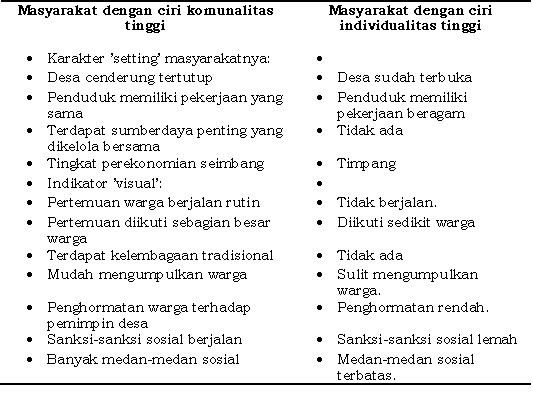
Masyarakat yang komunal vs yang individual

INTERAKSI yang sosial vs yang ekonomi


Pendekatan blue print vs learning proses


Perbandingan bank vs kelompok tani dalam penyediaan modal


Pembangunan ve Pemberdayaan


PETANI tradisional vs maju menurut berbagai pandangan


Contoh PERTANYAAN umum vs fokus pada Penelitian

Paradigma PENYULUHAN lama vs baru

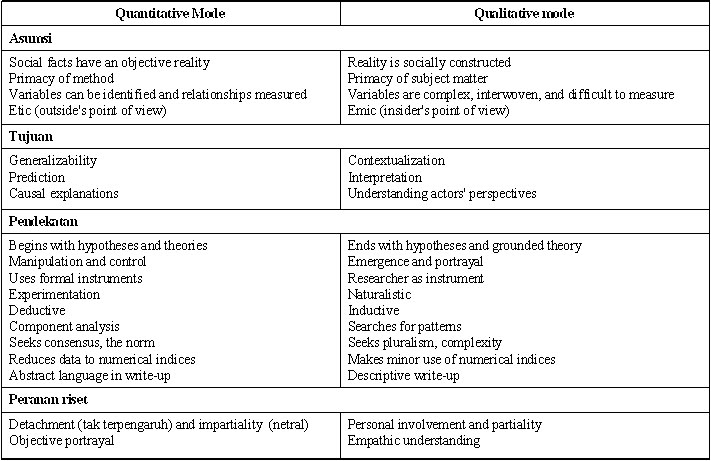
Metode penelitian Kuantitatif vs Kualitatif


Struktural fungsional vs Teori konflik


Human Capital vs Social Capital: Mana yang Lebih Diperlukan?

Oleh: Syahyuti (Puslitbang Sosial Ekonomi Pertanian, Bogor).

Konsep “sumberdaya manusia” (SDM) di Indonesia sudah sangat populer. Konsep ini menjadi landasan dalam merancang berbagai strategi pengembangan manusia. Banyak nama proyek dan program menggunakan frasa “pengembangan sumberdaya manusia”, bahkan di Deptan juga ada Badan Sumberdaya Manusia. Dalam konsep SDM ini, diasumsikan bahwa manusia dapat dikembangkan sebagai individu demi indvidu. Jika individu-individu dalam masyarakat berpendidikan baik, sehat, dan memiliki motivasi tinggi; maka diyakini akan mampu mendorong perubahan.

Dalam tulisan ini, saya ingin menyampaikan bahwa konsep “sumberdaya manusia” (human resources) tersebut masih mengandung kelemahan, atau lebih tepatnya “ketidaklengkapan”. Ia tidak lengkap karena hanya bertolak dari konsep human capital, human labour, dan intelectual capital, yang cenderung melihat manusia secara sempit. Disini manusia lebih dipandang sebagai objek ekonomi, atau sebagai kapital agar ekonomi suatu perusahaan (maupun sebuah wilayah) berkembang.

Agar kita bisa melihat manusia secara lebih utuh, maka satu lagi alat yang dibutuhkan adalah menambahkan konsep “social capital” (modal sosial). Hanya dengan memadukan konsep human capital dan social capital, maka analisis kita kepada manusia menjadi lengkap, karena keduanya sesungguhnya saling melengkapi. Jika konsep human capital merupakan hasil dari pemikiran para ahli ekonomi, maka social capital merupakan sumbangan dari ahli-ahli ilmu sosial. Social capital melengkapi pendekatan individual otonom yang merupakan karakter utama ilmu ekonomi dalam melihat manusia. Perbedaan secara diametris antara human capital (dan sekaligus tercakup human labour dan intelectual capital) dan social capital dapat dilihat pada Tabel berikut.


Dalam konsep human capital, manusia dilihat sebagai objek individual, merupakan kapital ekonomi, dan pengembangannya adalah dengan peningkatan kapasitas individual misalnya berupa peningkatan pengetahuan dan keterampilan. Sebaliknya, social capital melihat manusia sebagai makhluk sosial, yaitu bentuk relasi apa yang terjadi ketika manusia berinteraksi dengan manusia lain. Jika sebuah komunitas digambarkan dalam suatu rangkaian berupa titik (nodes) dan garis (lines), maka human capital menunjuk kepada “titik” sedangkan social capital menunjuk kepada “garis”.

Secara umum, sumberdaya manusia dimaknai sebagai “the persons employed in a business or organization”, dimana manusia adalah sumberdaya untuk bisnis. Manusia adalah kapital. Dalam pengertian tradisional, SDM adalah manusia yang ada dalam perusahaan dan bidang bisnis lain, yang menunjuk kepada individu-individu dalam perusahaan, berkaitan dengan rekruitmen, penggajian, pelatihan, dan lain-lain. Dalam pengertian ini, biasanya digunakan istilah “labor”. Ini merupakan pemaknaan yang sempit, yang hanya melihat pada aspek keterampilan dan kemampuan manusia dalam konteks “employment”. Dalam pengertian yang sederhana ini, manusia hanyalah faktor produksi dan sekaligus komoditas yang cenderung homogen dan dapat dengan mudah dipindahkan dan dipertukarkan dari satu tempat ke tempat lain, dari satu perusahaan ke perusahaan lain. SDM sama dengan "physical means of production", sebagaimana mesin dalam sebuah pabrik.

Dalam pandangan yang lebih modern, manusia (human beings) tidak hanya dipandang semata-mata sebagai sumber daya yang pasif dan bekerja sesuai kontrak belaka, namun dipandang sebagai makhluk sosial (social beings) yang dicirikan oleh daya kreatifitasnya yang tak dapat dikalahkan oleh makhluk lain di bumi ini. Manusia dihargai karena memiliki intellectual capital.

Kenapa penting mempelajari dan mengembangkan social capital dalam masyarakat? Karena dengan individu-indvidu berkualifikasi baik belum jaminan akan terciptanya sebuah kemajuan. Gampangnya begini, jika lima orang doktor ditugaskan merencanakan dan mengimplementasi satu program ke desa, maka belum jaminan akan berhasil jika di antara mereka tidak ada modal sosial yang berkembang.

Konsep social capital merupakan pelengkap dari banyak kapital yang sudah berkembang sebelumnya, yaitu natural capital, financial capital, physical capital, human capital, human made capital, dan intelectual capital. Social capital merupakan syarat penting untuk menggerakkan sebuah organisasi, bahkan untuk pembangunan. Untuk itu, social capital harus dikenali dan dikembangkan pula.

Konsep social capital dapat diterapkan untuk upaya pemberdayaan masyarakat. World Bank memberi perhatian yang tinggi dengan mengkaji peranan dan implementasi social capital khususnya untuk pengentasan kemiskinan di negara-negara berkembang. Menurut definisi World Bank, social capital adalah “…a society includes the institutions, the relationships, the attitudes and values that govern interactions among people and contribute to economic and social development”. Social capital menjadi semacam perekat yang mengikat semua orang dalam masyarakat. Di dalamnya berjalan “nilai saling berbagi” (shared values) serta pengorganisasian peran-peran (rules) yang diekspresikan dalam hubungan-hubungan personal (personal relationships), kepercayaan (trust), dan common sense tentang tanggung jawab bersama.

Jadi, elemen utama dalam social capital mencakup norms, reciprocity, trust, dan network. Social capital tercipta dari ratusan sampai ribuan interaksi antar orang setiap hari. Ia tidak berlokasi di diri pribadi atau dalam struktur sosial, tapi pada space between people. Ia menjadi pelengkap institusi. Social capital merupakan fenomena yang tumbuh dari bawah, yang berasal dari orang-orang yang membentuk koneksi sosial dan network yang didasarkan atas prinsip kepercayaan dalam hubungan yang saling menguntungkan (mutual reciprocity). Ia tidak dapat diciptakan oleh seorang individual, namun sangat tergantung kepada kapasitas masyarakat.

Bagaimana mengukur social capital? Meskipun belum ada kesepakatan, namun ada dua pendekatan untuk mengukurnya. Kita dapat melakukan sensus dengan menghitung jumlah grup atau kelompok sosial yang ada dan keanggotaan grup dalam suatu masyarakat. Dan kedua, dapat juga dengan pendekatan survey, dengan mengukur derajat kepercayaan dan daya kohesi dalam masyarakat (level of trust and civic engagement). Pada level mikro, social capital memfungsikan keteraturan sosial (social order) bersama-sama dengan perasaan bersama dan sikap berbagi (sense of belonging and shared behavioral norms). Sebagian ahli menganalogkan social capital sebagai “sinergi” yang dimiliki masyarakat tersebut. Masyarakat yang bersinergi tinggi adalah masyarakat yang bekerjasama dengan kuat, sementara masyarakat bersinergi rendah cenderung individualistis.

Kembali kepada judul di atas, maka konsep SDM kita selama ini perlu diperbaharui dengan menggabungkan berbagai konsep sebelumnya yang telah mencakup konsep human capital, human labour, dan intelectual capital; dan menambahi dengan konsep social capital. Jadi, konsep SDM baru mencakup keempatnya sekaligus, dimana pengembangan SDM mesti dilakukan secara individual dan relasi yang terbentuk antar individual. Atau dapat dikatakan, pengembangan SDM dapat menggunakan pendekatan individual ditambah pendekatan komunitas. Beberapa pendekatan pembangunan yang telah menggunakan konsep social capital misalnya adalah pendekatan Community Development dan Communiy Based Management. ********

Selasa, 24 Mei 2011

Perbedaan rata-rata vs rata-rata

Average vs Mean

Average or mean? Are there any differences?

The term ‘average’ is used to express that something is statistically the norm. It would mean that a value is expected, middle, usual or common. The ‘average’ represents a value that would best represent a sample.

In mathematics, we normally consider average as the sum of all values divided by the number of values added. Strictly speaking, it is the ‘arithmetic mean’, or simply referred to as the ‘mean’. The mean is almost considered synonymous with average, but statisticians will definitely disagree, because, in essence, mean is only a form of describing an average.

An average can be described in many ways. Aside from expressing it as the mean of the sample, it can also be given as the median or the mode.

Median is the central point of the set. In statistics, it is usually the number that occurs in the middle of a set of numbers. A description of the average can be in the median, some of the time, if it is considered as the most suitable way to describe the central tendency of a particular sample.

The mode is the value that occurs most frequently in a data set. It is also considered a form of average. It will state, that the most frequently occurring data, is the average of the sample. It is also one of the most common ways to express an average, next to mean.

Having said all of that, the term ‘average’ encompasses several ways to measure what value best characterizes a particular sample. The terms and measurements that are used will really depend on the situation. It will greatly be based on how you want describe a certain data set or sample.

Additionally, mean can be in many types as well, e.g. quadratic mean, harmonic mean, geometric mean, etc. Apparently, arithmetic mean is the only one that distinguishes itself as a form of average.

In language, people will normally use the term ‘average’ in casual conversations. Mean is usually used by mathematicians and statisticians.

Summary:

1. Average can be in mean (arithmetic mean), median, or mode. Mean is basically a form of describing an average of the sample.

2. Mean can be in many various types too, but only the arithmetic mean is considered as a form of average.

3. ‘Average’ is usually used in casual English conversation, while ‘mean’ is usually used in technical language.

Read more: Difference Between Average and Mean Difference Between Average vs Mean http://www.differencebetween.net/science/difference-between-average-and-mean/#ixzz1NGBXMmWq

Sumber:
http://www.differencebetween.net/science/difference-between-average-and-mean/

Perbedaan modern vs pos-modern

Modern vs Post-Modern

“Modern” and “post-modern” were terms that were developed in the 20th century. “Modern” is the term that describes the period from the 1890s to 1945, and “post-modern” refers to the period after the Second World War, mainly after 1968.

Modern is related to logical and rational thinking whereas post-modern has denied this logical thinking. While the modern approach was theoretical, objective and analytical, the post-modern approach was subjective.

The modernist was in search of an abstract truth of life whereas the post-modernist did not believe in abstract truth or in universal truth. In modernism, there was an attempt to develop a coherent worldview. But in post-modernism, there is an attempt to remove the differences between the high and the low.

A modern thinker believes in learning from the experiences of the past and also has much trust in the text that tells about the past. On the contrary, a post-modern thinker does not have such beliefs. The post-modernist thinks that the text that tells about the past is of no use in the present times.

When a modern thinker analyses a subject by going deep into it, the post-modern thinker does not believe in in-depth analysis. A post-modern thinker bases his views on hyper-reality whereas the modern thinker only considered original works as genuine. A post-modern thinker considers morality as relative.

When considering the arts, modern and post-modern art have many differences. While modern art is based on elegance and simplicity, post-modern art is considered elaborate and decorative.

When modern philosophy is based on effect and cause, post-modern philosophy is based on chance only. When modern thinkers consider truth as objective, the post-modern thinkers consider truth as relative and socially based. It can also be seen that post-modernists involve politics in everything whereas modernists are not that political.

Summary:

1.“Modern” is the term that describes the period from the 1890s to 1945, and “post-modern” refers to the period after the Second World War, mainly after 1968.
2.While the modern approach was theoretical, objective and analytical, the post-modern approach was subjective. (pendekatan modernisme adalah teoritis, objektif, dan analitis; sedangkan post modern adalah subjektif)
3.A modern thinker believes in learning from experiences of the past and also has much trust in the text that tells about the past. On the contrary, a post-modern thinker does not have such beliefs. (menurut kalangan modernisme manusia berfikir dari apa-apa yang sudah terjadi di masa lalu, sebaliknya menurut kalangan pos-modernisme, manusia tak mempercayai yang lalu-lalu itu)
4.While modern art is based on elegance and simplicity, post-modern art is considered elaborate and decorative.

Read more: Difference Between Modern and Post-Modern Difference Between Modern vs Post-Modern http://www.differencebetween.net/miscellaneous/culture-miscellaneous/difference-between-modern-and-post-modern/#ixzz1NG9BckhV

Sumber:
http://www.differencebetween.net/miscellaneous/culture-miscellaneous/difference-between-modern-and-post-modern/

Perbedaan fikiran vs jiwa

Mind vs Soul

Mind and soul are two concepts that are closely related yet very distinct from one another. They both come from the inner part of a human being, particularly his brain and maybe his heart.

The soul is the spiritual nature of humankind. It is the incorporeal essence of humankind, and it is thought to be separable from the body at death. In life, it is credited with the faculties of thought, action, and emotion.

The mind is man’s faculty of thinking, reasoning, and applying knowledge. It is human consciousness that starts in the brain and is manifested through man’s thoughts, actions, emotion, will, memory, and imagination.

Emotions like desire stem from our souls. Desires are aimed at things that are transient, those things that go away and die but at the same time will give us pleasure. Our minds are where we decide how to take pleasure, what we should do to achieve it, and how it should be fulfilled.

Most religions consider the soul to be man’s divine or God-given essence. While some religions believe that the soul will exit the body after death others believe that souls exist in all living things as well as in non living things.

The soul as the essence of the person decides how man behaves and this essence is an eternal part of our being. It is comprised of: the mind, our emotions, and our desires. The idea of the existence of souls is more closely connected to spirituality and religion.

For scientists, the soul is synonymous with the mind due to the fact that one can learn about the soul by studying the human brain where our minds are located. Still others believe that the soul is closely related to being alive and that when man is active, his soul is asleep; when man is asleep it is active through his dreams.

The mind on the other hand is used to refer to the individual’s thought process of reason and consciousness. It is synonymous with thought which is an individual’s private conversion with himself that is done inside his head.

Some psychologists believe that emotions like love, hate, fear, and joy are separate from the mind because only higher intellectual processes like memory and reason can be part of the mind.
For them, here are what makes up the mind:

1. Thought, which allows an individual to shape the world and deal with it to achieve his goals, plans, and desires.
2. Memory, which is a living organism’s ability to retain, store, and recall information.
3. Imagination, which is man’s ability to create ideas about certain things and experiences.
4. Consciousness, which is man’s ability to perceive his relationship to his environment.

Summary

1. Soul is the spiritual nature of man while mind is man’s faculty of thinking and reasoning.
2. The soul is considered as the essence of man while the mind is in charge of man’s consciousness and thoughts.
3. Our desires stem from our souls while our minds decide what actions to take in order to achieve our desires. (keinginan kita dari dari jiwa, sedangkan fikiran memutuskan apa tindakan yang akan kita ambil)

Read more: Difference Between Mind and Soul Difference Between Mind vs Soul http://www.differencebetween.net/language/difference-between-mind-and-soul/#ixzz1NG52Mtr6

Sumber:
http://www.differencebetween.net/language/difference-between-mind-and-soul/

Perbedaan keinginan vs kebutuhan

Want vs Need

When it comes to owning or acquiring certain things, people would often use the terms ‘want’ and ‘need’ interchangeably. In many cases, the manner in which people would use these two terms can lead one to perceive that these two have similar meanings, if not mean absolutely just the same thing. But actually, these two economic terminologies are very different from each other.

A need is generally referred to, in economics, as something that is extremely necessary for a person to survive. If a need is not met, it would lead to the onset of disease, the inability to function effectively and efficiently in society, and even death. Needs are categorized into two groups. There are the objective or physical needs, and the subjective needs. Objective needs are those that are met through tangible things, or things that could be measured. Examples of these include food, water, shelter and even air. On the other hand, subjective needs are those that are often seen to ensure our mental health. Examples of these are self-esteem, a sense of security and approval. A political professor, named Ian Gough, enumerated eleven distinct needs that must be met by each and every human being in order to function well in society, and to survive. The inability of meeting these needs can lead to a person suffering from illness (either physically or mentally), or even death.

On the other hand, a want is something that a person desires, either immediately or in the future. Unlike needs, wants are those that differ from one person to another. For example, one person may want to own a car, while another may want to travel to an exotic country. Each person has his or her own list of wants, each with a varying level of importance. Furthermore, wants can change over a period of time. This is in contrast to needs, which remain constant throughout the lifetime of the person.

The grey area between these two, is when the desire to obtain a particular thing is so extremely great, that a person may misinterpret a want, and see it more as a need. In order to know whether what you desire for is a want or a need, is to basically ask one fundamental question: “Have you been able to survive without this?” If your answer is ‘yes’, then what you desire for is a want, no matter how much you crave for it right now.


Summary:

1. Wants and needs are economic terminologies. (Keduanya merupakan konsep dalam bidang ilmu ekonomi).
2. A need is something that is necessary for a person to survive. On the other hand, a want refers to something that a person desires, either right now or in the future. (Kebutuhan merupakan hal yang penting untuk kehidupan, sedangkan keinginan hanyalah sesuatu yang diinginkan, padahal gak penting-penting amat).

3. Wants are desires that are optional, meaning that you will still be able to go on living, even if the want is not met. On the other hand, if a particular need is not met, it could lead to a person suffering from illness, or even death. (Keinginan hanyalah satu yang opsional, boleh ada boleh ga. Tapi, kalo kebutuhan kudu, harus ada, kalo ga ente bisa menderita).

Sumber:
http://www.differencebetween.net/language/difference-between-a-want-and-a-need/

Perbedaan fakta vs pendapat vs yang dipercayai

Fact vs opinion.

Fact and Opinion are really different in the sense that Fact is something that is true and Opinion is only a belief. Fact is supported by evidence and Opinion has no backing of any evidence.

A person who makes a factual statement knows that his opinion comes from Fact. Where as a person who just makes some Opinion does not have any facts to substantiate. While Facts are true statements Opinions are not. Opinion is only a subjective statement and Fact is objective reality. Opinion can only be an emotional outburst of an individual or merely an interpretation.

Facts can be proved to be true but an Opinion can be either true or not. Opinion cannot be proved to be true. Fact is not some perception but Opinion is just a perception of the thoughts. The fact is what all believe to be true, while the opinion is believed to be true only by those who state it.

The fact is what exists and opinion is just only an opinion and nothing else. People only endorse facts as they are true. Although people may have different opinions on any subjects, they can be either endorsed or disregarded. Opinion is only a choice while fact is the worthy. Even if people think that their opinion is true and worthy, it might not be regarded by others who have different opinion on their own. Meanwhile everyone agrees when someone tells a fact.

According to the Webster’s Dictionary, the fact is “anything that is done or happened; anything actually existent; any statement strictly true; truth; reality” and opinion is something that “indicates a belief, view, sentiment, or conception.”

Opinion is only just a thought or speculation and it can lead to controversies. It may tend to dispel the truth whereas a fact is only truth and truth itself.

Facts are strong statements and opinions can be biased statements. Facts always stay back in history whereas opinions are only views that may not get into history.

When people say a fact, they can easily influence others. But an opinion may not have the force to make an influence.

People sometimes find it hard to make a distinction between a fact and an opinion. The right understanding of the difference between fact and opinion is needed to evaluate things and to make judgments

Fact vs Truth

What is the clear difference between a fact and a truth? Well, if you look into most dictionaries, you will be amazed to find that the two words are actually very close in terms of their definitions. This is because the two terms are very much related. That’s why you really can’t blame people for recognizing both as similar terms.

Fact is basically something that exists, or is present in reality. Hence, these are things that can be seen visually, and these are the things that can actually be verified. Facts are objective matters rather than subjective ones. It is not just something that you believe, but rather these are more or less the things that can be observed empirically, or by the senses. So, facts can be seen and heard, as well as proven by the other senses.

Truth can be described as the true state of a certain matter, may it be a person, a place, a thing or an event. It is what a person has come to believe. If he believes that something is true, then it is true. It also answers the questions of what’s really happening. In the technical sense, facts can answer certain ‘why’ questions, like ‘where’ or ‘when’, and even ‘how’, while truth answers the question ‘why’. The question of ‘how’, and even ‘what’, are said to be answerable by either of the two.

In terms of permanence, a fact happens to be more permanent, and almost always seems to have no changes. It is more constant than truths. For example, when you say that the sun will always rise from the east and set in the west, you are telling a fact, but when you say that you are in Los Angeles, then that is a truth, at least for that exact moment. Several hours from that time you may have gone somewhere else, making your previous statement a fallacy. Thus, a truth is something that is not universal, it is more subjective, and depends on the current situation. That’s why the truth’s existence is said to be more temporary than that of facts.

1. Facts are more objective when compared to the more subjective truths.
2. Facts are more permanent when compared to the more temporary truths.
3. Facts exist in reality, whereas truths are usually the things that one believes to be true, or the things that are true in the current situation.
4. Facts can also answer the ‘where,’ ‘when’ and ‘how’ questions, whereas truths answer the ‘why’ question.

Sumber:
http://www.differencebetween.net/miscellaneous/difference-between-fact-and-truth/

Perbedaan subjektif vs objektif

Subjective vs Objective

In stories, newspapers, and the spoken word, people all over the world are trying to convince you to think as they do. They are bombarding you with facts and figures, opinions and projections. It is up to you to create order within this chaos and find the patterns that will help you to understand what is true, what could be true, and what is outright false. In order to do all this, you need to have a firm grip on what is objective and what is subjective.

Definition of Objective and Subjective

Objective is a statement that is completely unbiased. It is not touched by the speaker’s previous experiences or tastes. It is verifiable by looking up facts or performing mathematical calculations.

Subjective is a statement that has been colored by the character of the speaker or writer. It often has a basis in reality, but reflects the perspective through with the speaker views reality. It cannot be verified using concrete facts and figures.

When to Be Objective and Subjective

Objective : it is important to be objective when you are making any kind of a rational decision. It might involve purchasing something or deciding which job offer to take. You should also be objective when you are reading, especially news sources. Being objective when you are meeting and having discussions with new people helps you to keep your concentration focused on your goal, rather than on any emotions your meeting might trigger.

Subjective : can be used when nothing tangible is at stake. When you are watching a movie or reading a book for pleasure, being subjective and getting caught up in the world of the characters makes your experience more enjoyable. If you are discussing any type of art, you have to keep in mind that everyone’s opinions on a particular piece are subjective.

Easy Ways to Remember Objective and Subjective

Objective : sounds like the word object. You should be objective whenever you are discussing an object, something concrete that you can hold or touch. The facts that make up your objective statement should also be concrete, solid objects.

Subjective : is just the opposite. You can’t point to subjective subjects. They are all in your head and your past experiences. Subjective opinions are ephemeral and subject to any number of factors that can range from facts to emotions.

Examples of Objective and Subjective

Objective : scientific facts are objective as are mathematical proofs; essentially anything that can be backed up with solid data.

Subjective : opinions, interpretations, and any type of marketing presentation are all subjective.

Summary:
1.Objective and subjective statements are used by speakers to get their points across.
2.Objective statements are facts that can be verified by third parties while subjective statements may or may not be entirely true as they are colored by the opinions of the speaker.
3.Objective statements are most commonly found in the hard sciences, whereas subjective statements are generally used to describe the arts.

Read more: Difference Between Objective and Subjective Difference Between Objective vs Subjective http://www.differencebetween.net/language/difference-between-objective-and-subjective/#ixzz1NG25Yy73

Sumber:
http://www.differencebetween.net/language/difference-between-objective-and-subjective/